What is an SF double-wall tank, and how does interstitial leak monitoring work?
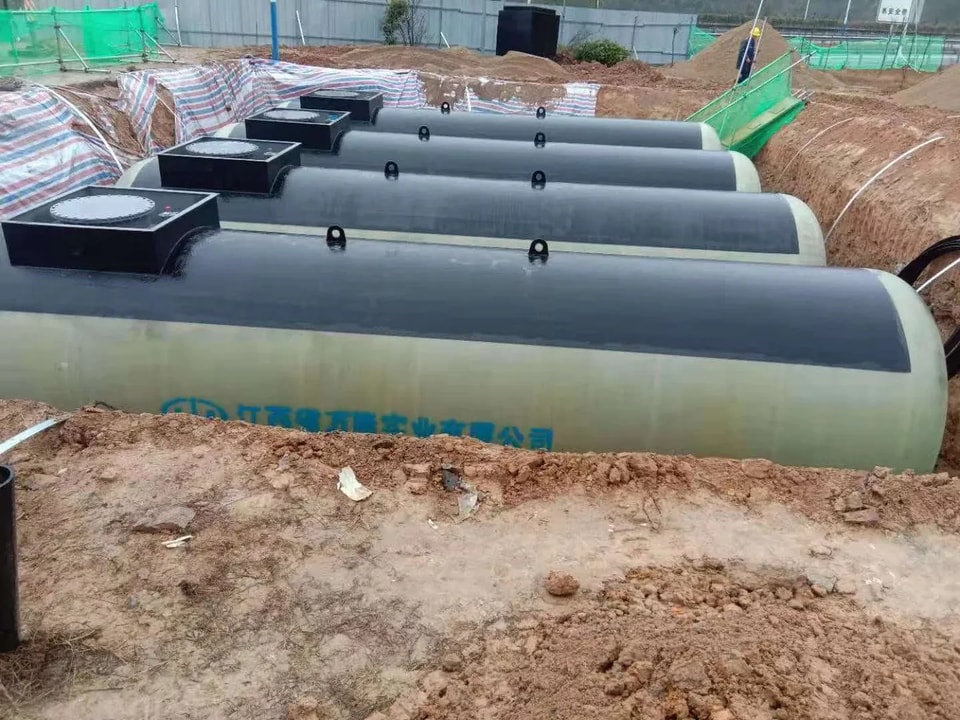
An SF double-wall tank is an underground fuel tank built as a steel tank inside a fibreglass-reinforced plastic (FRP) tank. S stands for the steel inner tank and F for the FRP outer tank. The narrow gap between the two walls, the interstitial space, is monitored. If either wall is breached, the change shows up in that space and raises an alarm, while the other wall still holds the fuel.
Two walls, two jobs
The steel inner tank holds the fuel and gives the tank its strength. The FRP outer tank keeps soil and groundwater away from the steel, which protects it from external corrosion, and it is the second barrier if the inner tank leaks.
That is why external corrosion protection is central to how these tanks are assessed. UL 1746, for example, is the standard for external corrosion protection systems for steel underground storage tanks.
How interstitial monitoring works
In normal service the interstitial space is closed and dry. A leak in the inner wall lets fuel into it. A leak in the outer wall lets groundwater in. A monitoring system watches for either change. Common approaches are:
- Liquid sensors: a sensor at the low point of the interstitial space detects fuel or water.
- Pressure or vacuum monitoring: the space is held at a set pressure or vacuum, and a breach in either wall makes the reading drift.
- Liquid-filled monitoring: the space is filled with a monitoring liquid, and a change in the level of its reservoir shows a breach.
The station designer and the local authority choose the method. The tank must then be built with the connections that method needs.
Why fuel stations use them
A single-wall buried tank gives no direct warning of a leak. The first sign may be a stock loss or contaminated soil. A double-wall tank detects a breach in either wall while the fuel is still contained, and the check runs continuously without excavation.
What to check when you specify one
- Nominal capacity, diameter and length against the pit and site layout
- The standard and certificates your authority requires
- The leak-monitoring method and its connections
- Manways, nozzles and, for several fuel grades, the number of compartments
- Groundwater level and burial depth, which affect anchoring and backfill
How Wanlong builds SF tanks
We build five standard sizes, SF-10 to SF-50, from 10 to 50 m³, with inside diameters of 2,400 to 2,800 mm. The inner tank is Q235B steel, 6 mm thick, welded by submerged-arc welding to qualified WPS/PQR. The outer tank is FRP, 6 mm thick, built up on our FRP spray lines. Tanks are manufactured to SH/T 3178. Our UL 1746 certificate is 20161115-MH61687, for jacketed underground tanks for flammable liquids, issued 2016. We supply SF tanks under framework agreements to a national fuel retailer's provincial station networks.
Send us the data sheet.
Tell us the medium, design pressure, temperature and quantity. An engineer replies with questions or a quotation.
- Sales contact
- Mr. Yu Jiakang
- WhatsApp / WeChat
- +86 183 1791 9067
- Factory
- No. 2666 Jinxian Avenue, High-tech Industrial Park, Jinxian Economic Development Zone, Nanchang, Jiangxi, China 331700

Pressure vessels, storage tanks, SF double-wall tanks, steel structures and skid-mounted units, fabricated in Jinxian, Jiangxi since 2003.
Jiangxi Wanlong Industrial Co., Ltd.
No. 2666 Jinxian Avenue, High-tech Industrial Park, Jinxian Economic Development Zone, Nanchang, Jiangxi, China 331700
Contact
- Mr. Yu Jiakang
- WhatsApp +86 183 1791 9067
- jiakang@wanlongindustrial.com


