Horizontal or vertical storage tank: how to choose for your site
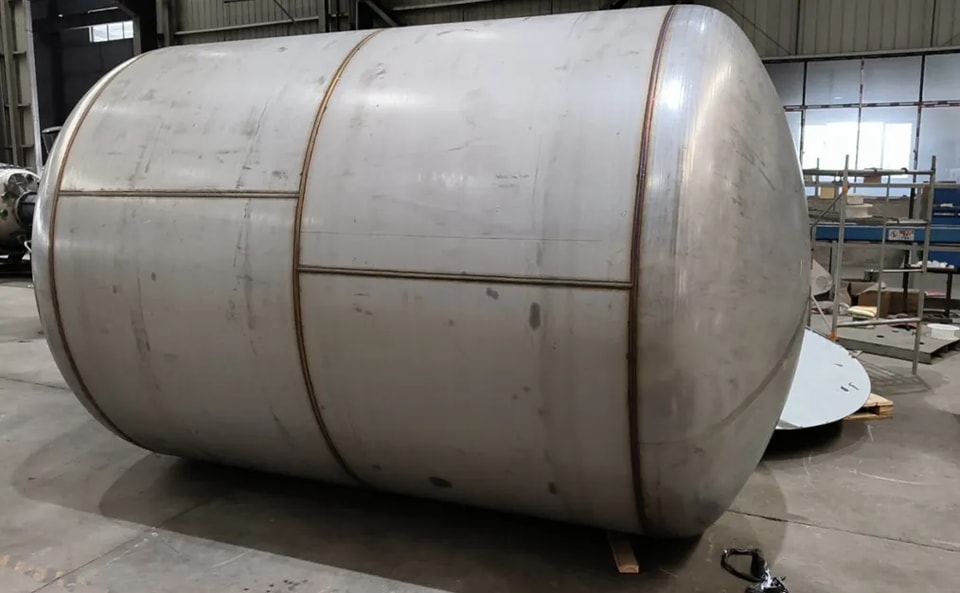
Choose a vertical tank when you need a large volume on a small footprint and the tank can stand on a prepared foundation. Choose a horizontal tank when the volume is moderate, the tank should be built and tested in the workshop and shipped whole, height is limited, or the tank must be buried. Most decisions come down to volume, ground space, transport and how the tank will be operated.
Volume and footprint
A vertical tank grows upward, so it holds more per square metre of ground. Large tanks are almost always vertical, and beyond shipping size they are built on site. A horizontal tank spreads its volume along its length. It needs more ground for the same volume, but it stays low.
Transport and build method
Road transport limits the diameter and length of a shop-built tank. Horizontal tanks are usually sized to ship whole on their saddles, so welding, inspection and testing happen in the workshop and site work is short. Vertical tanks above shipping size are prefabricated as plates and erected on site, which needs a crew, cranes and a longer site programme.
Foundations
A vertical tank puts its full weight on a circular footprint and needs a designed ring wall or slab. A horizontal tank sits on two saddles, each with its own footing. Soil conditions often decide the foundation cost, so check them before you choose.
Operation
- Draining: a vertical tank with a sloped or conical bottom drains to one point. A horizontal tank drains through a low nozzle and may be set with a slight slope.
- Level measurement: in a vertical tank the volume changes evenly with level. In a horizontal tank it does not, so the gauge needs a calibration table.
- Mixing: agitators and mixers are easier to fit in a vertical tank.
- Access: horizontal tanks are low, so manways, valves and instruments can be reached without tall platforms.
Pressure and burial
For pressure storage of moderate volumes, horizontal vessels with two heads are common because they are compact and tested in the workshop. For buried service, such as underground fuel tanks at stations, horizontal tanks are the norm.
A quick checklist
- Required working volume and number of tanks
- Available ground area and height limits
- Transport route and size limits to site
- Medium, design pressure and design temperature
- Draining, mixing and cleaning needs
- Aboveground or buried installation
How Wanlong handles it
We build both. Horizontal tanks are completed in our workshop in Jinxian and shipped whole. Large vertical tanks are prefabricated there and erected on site; our references include a 10,000 m³ wax-oil tank. Shells are rolled on 3- and 4-roll benders from plate up to 70 mm, with wall thicknesses of 6 to 70 mm. Tanks built as pressure vessels fall under our Class D licence for −0.1 to below 10 MPa and are hydrostatically tested at 1.25 × design pressure with a 30-minute hold. Send the medium, volume and site limits, and we propose the arrangement.
Send us the data sheet.
Tell us the medium, design pressure, temperature and quantity. An engineer replies with questions or a quotation.
- Sales contact
- Mr. Yu Jiakang
- WhatsApp / WeChat
- +86 183 1791 9067
- Factory
- No. 2666 Jinxian Avenue, High-tech Industrial Park, Jinxian Economic Development Zone, Nanchang, Jiangxi, China 331700

Pressure vessels, storage tanks, SF double-wall tanks, steel structures and skid-mounted units, fabricated in Jinxian, Jiangxi since 2003.
Jiangxi Wanlong Industrial Co., Ltd.
No. 2666 Jinxian Avenue, High-tech Industrial Park, Jinxian Economic Development Zone, Nanchang, Jiangxi, China 331700
Contact
- Mr. Yu Jiakang
- WhatsApp +86 183 1791 9067
- jiakang@wanlongindustrial.com


